An overwhelming 94 percent voted to reject the offer, with 96 percent voting in favour of striking. Workers are frustrated over years of stagnant wages and concessions made on pensions and healthcare to keep jobs being outsourced.
In a statement, IAM vowed to:
“Continue fighting for a contract that meets workers’ needs, with strong solidarity across North America backing the strike. Workers are saying, our future our fight.”
IndustriALL aerospace director Georg Leutert said:
“We stand in solidarity with the workers at Boeing.Co, it is their right to strike and demand better lives for themselves and their families. We stand behind them during this challenging time and hope that an acceptable and beneficial agreement can be reached.”
Photo: International Association of Machinists and Aerospace Workers (IAM) website.
IndustriALL’s aerospace sector prioritizes trade union rights in emerging economies
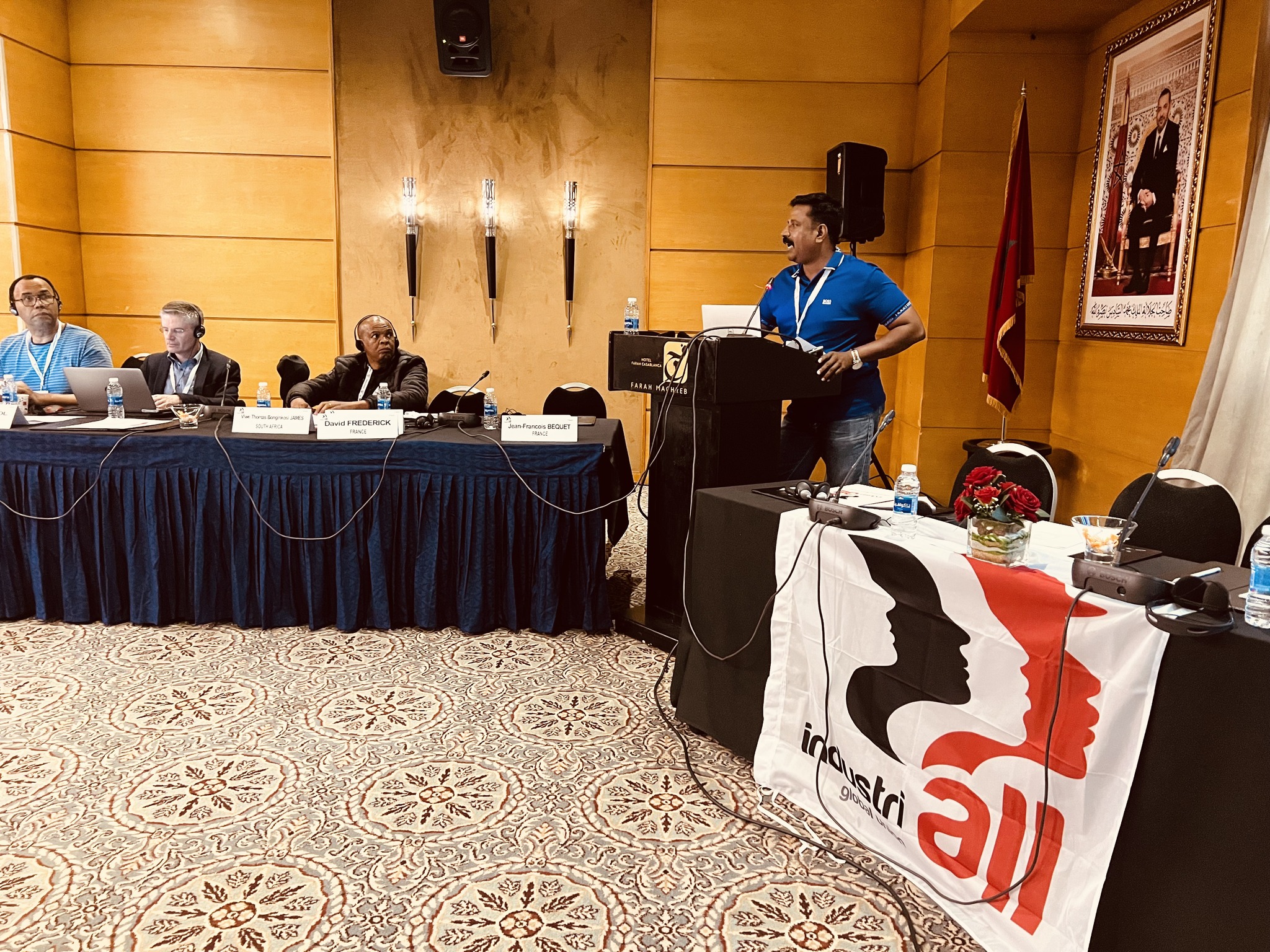
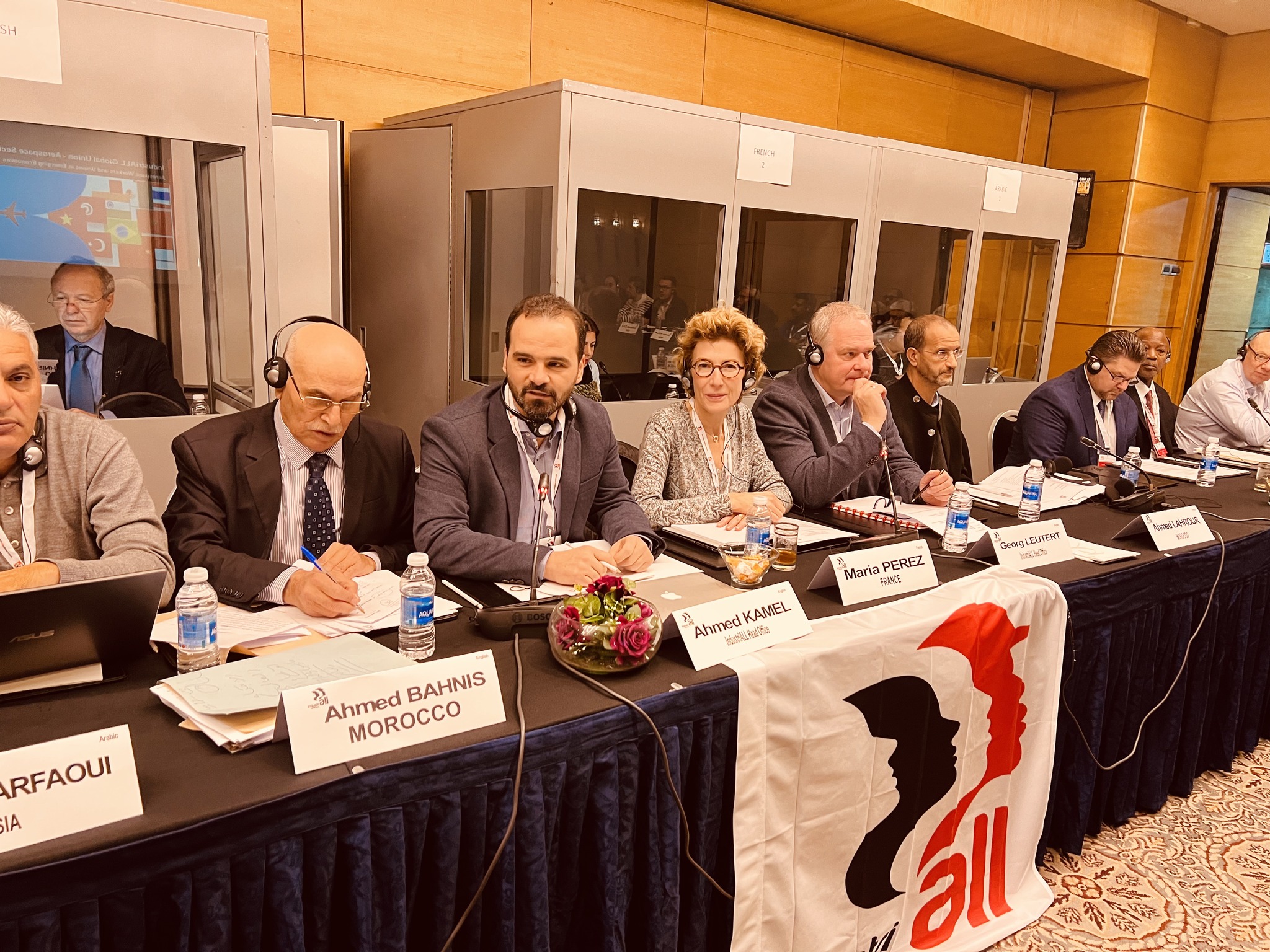
IndustriALL aerospace director Georg Leutert stressed the importance of union work being global:
"We need to broaden our perspective and participation. We all share the same values, and we need to make that a reality along the supply chain around the world. Workers have global rights and global trade union networks is a way to build knowledge and support. We can learn a lot from each other; focus on best practice and spread it."
Mahmood Arbouch, from Morocco's policy center for the new south, gave an overview of the aerospace industry in the country, which currently employs 41 per cent women, mainly in wiring harnesses. The aerospace industry is growing in both Morocco and Tunisia, although challenges ahead include a full recovery from effects of the global Covid pandemic, global supply disruptions, keeping up with digitalization, climate change and its implications on the industry, reducing skills gaps and preparing for increasing passenger traffic.
Abdelaziz Arfaoul, FGME-UGTT general secretary, described the challenges for workers in the sector in Tunisia, a country with high unemployment and political instability, affected by the war in Ukraine and the aftermath of the global pandemic. Unions need to address the hazardous working conditions in the aerospace industry, as well as the low salaries. There is an impression that many dangerous and labour intensive jobs are outsourced to the MENA region.
Participants from Morocco and Tunisia expressed the need for social justice and raised the question as to how it is achieved. The aerospace sector is witnessing rapid growth, and precarious contracts are a problem in the region, as is union busting. There are examples of multinational companies that work well with unions in their home country but disrespect their own codes of conduct in the region.
“Morocco and Tunisia are emerging countries for the industry, where serious efforts to organize the workers are underway and union power is growing to counter union busting,”
said IndustriALL regional secretary Ahmed Kamel.
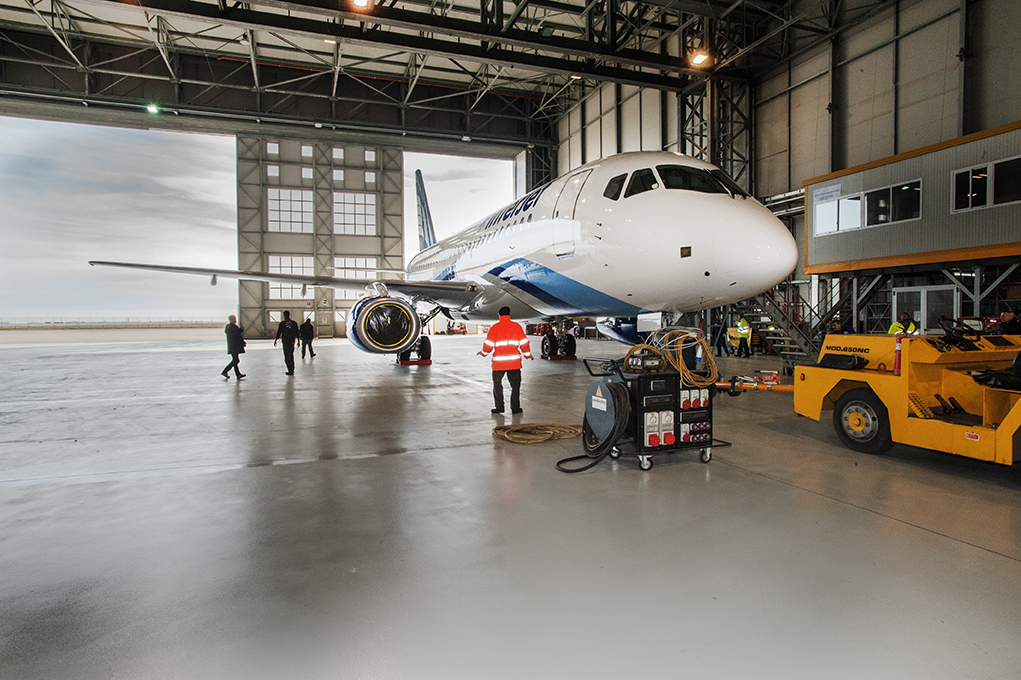
Outsourcing is a major problem at Embraer in Brazil. Brazilian colleagues told the meeting of the company's refusal to sign a CBA, resulting in layoffs and increased outsourcing.
In 2020, Embraer laid off 2,500 workers – at the same time the number of outsourced workers increased by 19,11 per cent. There is a strong turnover process of laying off older workers and hiring outsourced workers instead at 1/3 of the salary, all of which has a direct consequence on the safety in the workplace.
Taking action over poor wages and working conditions, workers at several TATA aerospace companies in India formed a union and started to organize. The employer responded by dismissing them. The union then brought the case to the labour department, but as the company is located in a special economic zone, the laws under the labour department are not valid.
“We have filed a petition in the hight court. We don’t want money; we want reinstatement. We are fighting for basic human rights. We fight for a safer and better future for our children,”
said R.D.Chandra Shekar, working president, TATA Advanced Aerospace Systems Workers Trade Union Congress.
Aerospace workers across globe face the same challenges and problems, it is the degrees that vary.
John Holden and Richard Jackson from US Machinists Union described the situation in Washington state and how the union works to maintain and provide good union jobs in their communities. Creating the Machinist Institute has opened an opportunity to provide hands-on training for workers to grow in the workplace. They are also looking to provide childcare at night and on weekends, which can be a stumbling block, especially for women workers, from taking advantage of advancement or even keeping the job you have.
Ian Waddell from UK’s Unite the Union talked about the triple crises Europe is currently facing – energy crisis, raw material crisis and a cost-of-living crisis. To tackle it, unions are calling for urgent action to tackle the energy crisis without neglecting climate change, solutions for critical raw materials and higher wages for workers.
Participants in the meeting also discussed priorities going forward, which include decarbonization, digitization and supply chain due diligence.
The meeting concluded with the adoption of a solidarity resolution on the trade union situation in Morocco, Tunisia, India and Brazil, and a promise to support to improve and resolve issues.
“The future of the aerospace industry will depend on the ability to decarbonize aviation. Trade unions have to be involved in this massive transformation from the very beginning to make sure that it is just and socially responsible,”
said Maria Perez from French union Force Ouvrière and sector co-chair.
Aviation unions welcome global agreement on net-zero carbon emissions by 2050
After weeks of negotiations, 184 countries agreed to a net-zero goal by 2050 for the aviation industry at the 41st General Assembly of International Civil Aviation Organisation (ICAO), a specialised agency of the United Nations.
Trade unions representing aviation and aerospace workers have long been calling for increased international ambition on decarbonisation stressing that all countries, industries, and workers have a role to play in decarbonising the entire aviation sector.
In the run up to the event, the International Transport Workers Federation (ITF), IndustriALL Global Union, the European Transport Workers Federation (ETF) and IndustriAll European Trade Union worked together to draft joint trade union demands. The working paper submitted to ICAO by trade unions called for a Just Transition for a zero-carbon future which emphasised the need for the decarbonisation of the aviation industry to be managed in a socially responsible way. It called for quality social dialogue, investment into training and the creation of sectoral action plans by social partners with the relevant authorities.
Unfortunately, the final declaration, being unbinding, only urged states to achieve the goal “in a socially, economically and environmentally sustainable manner and in accordance with national circumstances’’.
The final ICAO resolution and the adoption of the long-term global aspirational goal (LTAG) of net-zero carbon emissions by 2050 has received mixed reactions, with some positive comments from the European Union and European industry. NGOs have been more critical due to the non-binding nature of the agreement.
Georg Leutert, IndustriALL director for the aerospace industry said:
“The aerospace industry is under pressure to come up with zero-emission solutions based on global standards. The longer this takes, the more workers will pay for the resulting deficits. This is why we as unions must engage in the implementation of LTAG and related policies.”
Gabriel Mocho Rodriguez, ITF Civil Aviation secretary said:
"We are in a race against time to secure a sustainable future. Millions of aviation workers are experiencing the effects of climate change first hand, which is making the aviation workplace more dangerous. Increasing air turbulence poses a major risk to passengers and flight crew, extreme heat is disrupting airport operations, and rising sea levels threaten to inundate airports. The ICAO LTAGs were hard to achieve to this point, but if we are to move action forward with the speed that we need, workers must be driving decarbonisation and the aviation industry's transition."
Isabelle Barthes, industriAll Europe deputy general secretary said:
‘’Climate change is a global issue and we will continue to call on all countries and regions to step up their efforts in reducing the climate impact of flying including via the uptake of sustainable aviation fuels and the development of carbon-neutral aircraft. Workers are at the heart of the green transition, but unfortunately seem to have been forgotten in ICAO’s declaration! We insist on quality social dialogue and proper support to ensure that no worker or region is left behind, the green transition must be a Just Transition.’’
Eoin Coates, head of the ETF Civil Aviation Section, said:
“Social expectations and environmental goals must go hand in hand. Workers need to be at the heart of the environmental transition process, a transition that must be just and allows workers to be an active part, from design to implementation. They must be helped to adapt to the new developments and have guaranteed healthy and sustainable jobs as the aviation industry becomes a greener sector. While we welcome the progress the LTAG makes on the environmental sustainability of the industry, there is still a lot of work to be done on its social sustainability.”
Green aviation: trade unions demand strong international commitment with social sustainability and a Just Transition
This week, international and European trade unions representing workers in the aerospace and aviation sectors met to discuss a united position ahead of the International Civil Aviation Organization (ICAO) Assembly in September, at which it is hoped that the future pathway towards sustainable aviation will be agreed by international governments and key industry stakeholders.
At such a critical time, where the aviation industry faces the urgent challenge of responding the continued fallout from the Covid crisis, unions have identified the need for a coordinated industry-wide response from airlines, airports, governments, and unions to rectify capacity shortages, flight delays and beleaguered service levels that have plagued the industry for months.
Workers’ participation is critical, not just in fixing the underlying issues that are currently crippling the industry, but crucially in the addressing the long-term sustainability and decarbonisation of the industry. Workers’ participation will be essential in the social management of such a major industrial change. Climate justice cannot exist without labor justice with decent work being created through freedom of association and collective bargaining.
The meeting organized by IndustriALL Global Trade Union, International Transport Workers’ Federation, and their European counterparts industriAll European Trade Union and the European Transport Workers’ Federation follow successful collaboration on the Toulouse Declaration on the future sustainability and decarbonisation of aviation.
The aerospace and aviation sectors are intrinsically linked. Global trade union federations are particularly important in these processes playing a key role linking common needs and are essential in turning them into an international vision and strategy. Trade unions from both sectors see significant opportunities offered by a combined and cross-sectoral approach, based on a supply chain-wide vision and an international industrial strategy that is built on foundations of sustainability and decent work.
Lockout at Canadian Rolls-Royce site
The 530 aircraft engine maintenance workers have been without a collective agreement since March 2020. Negotiations had been progressing slowly, and at the meeting, workers voted 94 per cent in favour of giving their union a mandate to call a strike at the appropriate time. During the meeting, the president of the company declared a lockout. The union responded by exercising its mandate immediately, and called a strike. The workers have been picketing outside the factory gates since the beginning of the lockout at 1pm that day.
The workers are represented by IndustriALL Global Union affiliate the Syndicat des travailleuses et des travailleurs de Rolls-Royce Canada (CSN). The union wants a five-year contract. Among other things, they are demanding the elimination of orphan clauses in the pension and group insurance plans, improved wages and work schedules, and enhanced leave.
“For months we have been arguing at the bargaining table for the needs of Rolls-Royce workers to be taken into account,” explains union president Frédéric Labelle.
“The employer's response has been disappointing. The more dismissive they are, the more our sense of belonging erodes. We are the core of this business. Without our work, which is recognized in the industry as being of outstanding quality, Rolls-Royce could not call itself a leader. We want to be treated with respect again.”
Prior to yesterday's strike vote, the union organized a number of actions to make it clear to the employer that the workers are committed to their demands. There was strong participation by the membership. There have been 25 bargaining sessions over the past few months, and members have followed the progress closely. There is strong support for the bargaining committee.
IndustriALL general secretary Atle Høie sent a message of support to the union, saying:
“We find it unconscionable that the company in the middle of negotiations opted for a lockout rather than a social dialogue, particularly bearing in mind that the 530 specialized workers at the Côte-de-Liesse factory have been without a collective agreement since March 2020.”
Photos: CSN
IndustriALL, ITF and TUAC urge action on export credit to revive global economy
IndustriALL Global Union, the International Transport Workers’ Federation (ITF) and the Trade Union Advisory Committee (TUAC) are calling for OECD countries to protect jobs and revive the global economy by strengthening and coordinating:
Export credit agencies (ECAs) support for financing matters related to the aerospace and commercial aviation sectors
Strengthening ECA “Common approaches” relating to human rights, including labor standards and due diligence initiatives
Inclusion of trade unions and other NGOs and transparency in basic decision-making
“In theory, aviation is expected to be back at previous levels in 2025. But if it is to survive we need to keep the industry going now. Export credits are a way forward to stimulate the aerospace industry as that would facilitate orders and then deliveries,”
said Atle Høie, IndustriALL assistant general secretary.
“In addition, OECD policies on export credits would ensure the promotion of decent jobs and working conditions.”
Rob Johnston, ITF Assistant General Secretary said that it is vitally important that ECAs consider labour standards and sustainability issues before granting access to finance as this is the only way to ensure a level playing field.
“Both ITF and IndustriALL understand the importance of export credit agencies as millions of jobs rely on them. But it is also critically important to ensure that we link corporate behaviours to improving global labour practices,”
said Johnston.
ECAs could also promote the renewal of airline fleets, which will be necessary for the industry, not least from a climate perspective to reduce CO2 emissions in future aviaton.
The call for action follows months of cooperation between the global unions on export credits, culminating in a formal submission to the OECD Export Credit Agency in October 2020.
Heightened competition between countries has led to individual ECAs lowering their own policies that support jobs. Trade unions are particularly alarmed at competition from non-OECD members that are not party to the Common Approach framework. This underscores the need for OECD member states to work harder to coordinate policies to restore the global economy.
Human rights due diligence must also be strengthened and involve trade unions and other NGOs, especially during the ongoing pandemic. Workers can be the most effective means of identifying, monitoring, reporting and remedying negative environmental and human rights violations in businesses, industries and supply chains.
Union deal saves Rolls-Royce Barnoldswick
The Rolls-Royce jet engine factory in Barnoldswick in the United Kingdom has been saved after a nine weeks of strike action. The future of the factory was thrown into doubt last summer when Rolls-Royce announced that it was transferring the production of its Trent jet engine blade work to Singapore. The workforce balloted for industrial action and began targeted strike action on 6 November last year which ran until Christmas Eve. Workers returned to the picket lines at the start of 2021.
The small town of Barnoldswick, home to just 11,000 people, mobilized in defence of their community. The Rolls-Royce factory, which has been in operation since 1943, is the birthplace of the jet engine and the main employer. The closure of the site would have had devastating consequences for the prosperity of the local community.
The dispute was widely supported in the UK, and IndustriALL Global Union affiliates from around the globe stood shoulder to shoulder with the colleagues, sending messages of solidarity.
Unite has long criticized the UK government for its failure to develop an industrial strategy that invests in the development, growth and transition of manufacturing. Despite the lack of political support, the union negotiated a deal that saves jobs and manufacturing capacity while preparing for the future.
The deal, which is supported overwhelmingly by the workforce, will give the historic site a new lease of life as a core manufacturing facility and host to a new centre of excellence, training engineers to meet the challenges of the climate emergency.
The main details of the deal are:
A ten-year manufacturing guarantee for the site
A guaranteed minimum headcount of 350 workers
The creation of a centre of excellence training school supporting the development and manufacture of zero carbon technologies
A guarantee of a two year no compulsory redundancy agreement to facilitate discussions on a plan for advanced manufacturing work, supporting carbon free energy generation, along with synthetic fuels and green technologies.
IndustriALL assistant general secretary Atle Høie said:
“This dispute has been very important to the IndustriALL global aerospace steering committee because it sets such an important precedent. This deal is testament to the tenacity and courage of the members, as well as the willingness of the company to negotiate in good faith and listen to the union’s alternative business case. We believe that this groundbreaking deal shows a way forward for the sector, preserving jobs and skills while preparing for the future.
IndustriALL aerospace director Georg Leutert said:
“Rolls-Royce is one of the most important companies in the sector, and one of the few to allow trade unionists to meet regularly at a global level. Rolls-Royce reps have a permanent seat on the aerospace sector committee. IndustriALL, Unite and the company hope to meet soon to discuss social dialogue at global level.”
US union calls on Safran to extend contract
Workers United has bargained with Safran since September for a new agreement. Negotiations broke down when the employer refused to accept pay increases for the coming three years and insisted that they would be able to use any criteria to lay-off or recall workers. Safran already has the right to lay-off and recall employees in tiers of most efficient workers and least efficient workers.
The union says that although they tried to find middle ground, they have been met by a brick wall.
“We are prepared to meet Safran, a multi-billion-dollar company, in the middle to find a way forward to come up with a reasonable contract that will benefit the success of the plant and the workers. How is it fair for Safran to ask for the women, who are already low-wage workers, to continue to sacrifice?”
IndustriALL and Safran signed a global framework agreement in 2017 on working conditions, corporate social responsibility and sustainable development.
IndustriALL general secretary Valter Sanches says:
“In the spirit of our joint global framework agreement, I urge you to intervene immediately to ensure that Safran in Mississippi extends the union contract and engages in genuine bargaining with Workers United.”
Photo credit: Adrien Daste / Safran
Aerospace companies must assume responsibility in Morocco and Tunisia
As redundancy plans are presented in the MENA region, companies fail to assume responsibility. After benefiting considerably from the workers in Morocco and Tunisia, companies now dismiss staff without respecting the law.
The IndustriALL MENA aerospace union network discussed the consequences of the Covid-19 crisis and union responses together with the aerospace sector co-chairs from the US and France.
Participants denounced multinational companies who lay-off employees without fully respecting national laws, collective agreements and the rules of proper social dialogue. The MENA region, and apart from the Gulf States particularly in Morocco and Tunisia, has become an important hub for the aerospace industry, as well as for maintenance, repair and overhaul of aircrafts and engines. More than 35,000 employees work in more than 250 companies in Morocco and Tunisia, with wiring harnesses being a major product.
Big global aerospace companies like Stelia (Airbus), Boeing and Safran have invested in the region over the past two decades because of low labour costs, a qualified work force, state incentives (e.g. special economic zones) and a proximity to Europe.
However, labour conditions are often poor with long shifts and hourly wages of less than US$2. Many companies also fight workers’ right to form a union, and fire trade unionists when they become aware of an organizing campaign.
Tahar Berberi, general secretary of Fédération Générale de la Métallurgie et de l'Electronique (FGME-UGTT), Tunisia, underlines that there is no social protection for workers and losing a job means immediate poverty.
“The companies ignore this and walk away from their responsibility. Right now, we want to negotiate solutions to avoid redundancies, like short-time work, reduction of working time for all etc. Further on, we want to add elements of social security into the bargaining agreements.”
Boutayeb Bouchkhachakh, vice general secretary of Syndicat National des Industries Métallurgiques et Électromécanique (SNIME- CDT), Morocco, says:
“According to Moroccan labour law, employers are obliged to pay employees a compensation of 1.5 months per year in case of a redundancies on economic grounds. In reality, they often try to get away with less than that.”
In the companies where workers are organized, unions fight back and have successfully negotiated alternative solutions to significantly reduce the number of dismissals. SNIME-CDT and UMT representatives report that through industrial action and negotiations, planned redundancies have been reduced and socially responsible solutions had been found, including temporary layoffs with a right to return to work after one year.
Atle Høie, IndustriALL assistant general secretary, says:
”We are working closely with our MENA affiliates to intensify union work in the sector. With the current crisis, employers need to understand that dialogue with unions is how we reach long-term, sustainable solutions.”
The global aerospace industry – close to a crash landing?
REPORT
National lockdowns and travel bans have had a tremendous effect on aviation. Over the last eight weeks, around 80 per cent of all commercial airplanes have been grounded with enormous negative effects on the financial situation of most airlines.
Unless governments intervene, there will be insolvencies. Even if the worst can be avoided, there will be job losses at airlines, maintenance and airports but also in the aerospace manufacturing sector, as orders for new aircrafts are delayed or cancelled.
News of severe job cuts are almost daily; the most prominent so far are 9,000 jobs at Rolls Royce; around 10,000, or 25 per cent of the entire workforce, at GE aviation; 16,000, or 10 per cent of the workforce in the commercial aircraft sector at Boeing; and some 5,000 jobs at Safran.
The massive reaction by the companies indicate that the market will not make a quick recovery. Initial forecasts speak about five years as a minimum for the sector to recover to pre-Covid numbers. Why will it take so long? Shouldn’t the sector get back on its feet once the restrictions related to Covid-19 are fully removed?
What else is behind the turmoil? The current crisis reveals a number of issues that existed before and have now turned into real problems.
Unions need to be actively involved in resolving the current crisis, and as the sector has become more global in the past ten years, global union cooperation and social dialogue are of key importance for sustainable and just future strategies.
What are the key issues?
Highly capital-intensive
Commercial aerospace is a capital intensive industry with a limited number of big actors. While the development of a new aircraft is a two-digit multi-billion-dollar business, profit margins remain low, at around 2-4 per cent.
For major suppliers, particularly at propulsion manufacturers, profit margins are far higher. The reason for this is less in engine production, but in the highly profitable maintenance, repair and overhaul (MRO) operations on the aftermarket.
The huge financial dimensions are reflected on the balance sheets of the airlines. Not long ago some airlines spent billions of dollars every year to renew and/or grow their fleet as they were sitting on considerable profits. Today, after an eight weeks’ Covid-19 stress test, many of the same airlines are close to insolvency.
Never-ending duel between Boeing and Airbus
The commercial aircraft industry is dominated by the two archrivals Boeing and Airbus. When Airbus took over large parts of Bombardier and Boeing was close to doing a similar deal with Embraer this duopoly seemed even further consolidated.
Another important chapter of the duel is the ongoing allegations regarding unfair business practices and illegal state aid/subsidies related to large civil aircrafts. Since 2005, the US and the EU/the four countries with major Airbus operations, France, Germany, Spain and the UK, have invested considerable resources in a related dispute at the World Trade Organization.
Today, after the Covid-19 shock, both companies are confronted with a new situation. Instead of adding new contracts to their full order books they find themselves having to make concessions to sell aircrafts. Both operators are forced to accept deferrals and cancellations, as it could otherwise provoke bankruptcy of their main customers.
When two quarrel, a third rejoices
In the shadow of the duel, and partly with their indirect support, a third competitor has emerged, Chinese state-owned COMAC. Although experts say that the new manufacturer will still need some time to be fully competitive at an international level, there is a good chance for COMAC to win future business in China and Asia, which is forecasted to be the strongest future growth region.
Moreover, we shouldn’t forget that the Brazilian Embraer is now an independent manufacturer again with an important presence on the market. The Russian aerospace industry has the potential to play a more important role in the future, partly in cooperation with COMAC on the joint CR929 project (twin-aisles long distance jet). And Mitsubishi also has strong ambitions to become an important player in the regional jet market.
An unrealistic growth scenario? Certainly unsustainable!
The pre-Covid growth scenarios of the aerospace industry were based on five assumptions:
The global middle class will grow, particularly in Asia, and create an additional high demand for air travel
The economy will continue to be highly globalized and a long-term high demand for business travel is a given
The number of regional airports will continue to grow and will increase air traffic
Based on customer preferences, air travel via hubs will be more and more complemented, and partly replaced, by more direct connections
The co-existence of network airlines and low-cost carriers is economically viable and will guarantee continued growth
Today, a number of these assumptions are less realistic.
Video conferences and teleworking will partly replace (business) travel
Forced to work from home, many business travelers have discovered the advantages of video conferencing: nearly no technical issues, far more time flexibility, cost savings etc.
Unsustainable business models
Now, network airlines admit that many of their national flights are not profitable and that they would be happy to replace them by fast train connections
The low-cost flight market is barely profitable
The competition between network and low-cost airlines is partly destructive
Going green – aerospace is far behind
Industries without a viable strategy to significantly reduce their carbon footprint are not sustainable and will go out of the market. Industries who are not serious about their strategies and fool customers and governments lose credibility and will come under increasing pressure to reform.
Learning from the car industry, the aerospace industry should intensify efforts to make air travel cleaner and greener. That the carbon emissions of modern commercial aircrafts are 40 per cent lower compared to the former generation is hopefully a figure based on facts and not wishful thinking. So far, there has been no break-through technical solution to power an aircraft without kerosene. Electric motors could be applied to reduce emissions e.g. during taxiing on the ground, but the improvement will be rather marginal.
Aviation has to be fully integrated into future multi-modal transport concepts. The promotion of more direct flight connections combined with a lower utilization of the hub concept is not a green solution. The same is true for a policy aiming at growing the number of regional airports even more.
When will Covid-19 restrictions end?
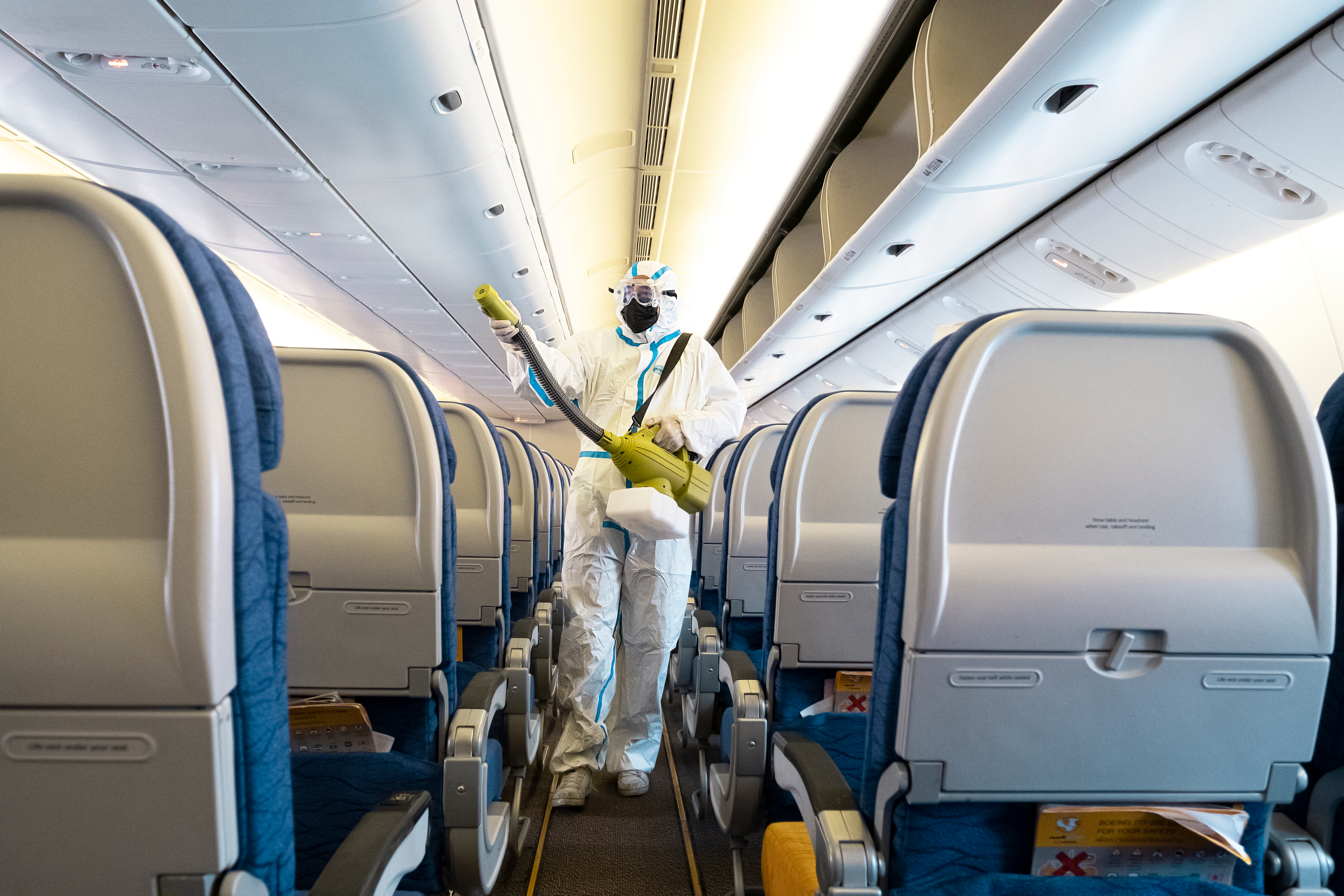
The coronavirus is a severe threat to the future of commercial aviation. Apart from the uncertainty of when confinement measures will be fully lifted and of if there will be further waves of Covid-19, the most important question is if and when passengers will accept to sit closely together again.
A global industry that is only starting to develop global structures
Although sales, operations, maintenance, repair and overhaul of aircrafts are fully global businesses, the manufacturing networks and supply chains are less globalized. Outsourcing production to low-cost countries, mainly Mexico and the MENA region, begun at a low scale about 20 years ago. Global supply networks have grown considerably since then, including huge research and developments operations in India, but there is a lot more to come.
ACTION PLAN
Improve global trade union cooperation and dialogue with the companies
From a trade union perspective, the sector still lacks a genuine global approach. There are no real global trade union networks (TUN) at company level and it would be advantageous with more global framework agreements, in addition to the existing three with Airbus, Saab and Safran.
The fast exchange of information and even some coordinated joint action that are key features in many auto TUNs for example, would be beneficial for the aerospace sector and would have helped during the current crisis.
Lobby governments and join forces with the International Transport Federation
Unions must work with governments to create a scenario that helps to stabilize the current situation and to work jointly on a sustainable industrial strategy for the sector. IndustriALL Global Union and the International Transport Workers’ Federation intend to join forces and work more closely together. Both federations will establish a joint working group and will work together on an important research project.
Focus more on emerging economies
As many aerospace companies are still in the process of growing its global presence and as supply chains become more global, IndustriALL Global Union will increase its efforts to build and support trade unions in emerging economies, in particular in the MENA region, India and Mexico. Subject to Covid-19, the sector steering committee intends to hold an important conference in the MENA region by the end of 2020.